
The Audit That Created the Roadmap: Website Audit Strategy for SEO and Conversion
Part 2 of the J Luxe rebuild series: how a structured website audit, technical SEO audit, and conversion audit created a clear rebuild roadmap without wasted redesign work.
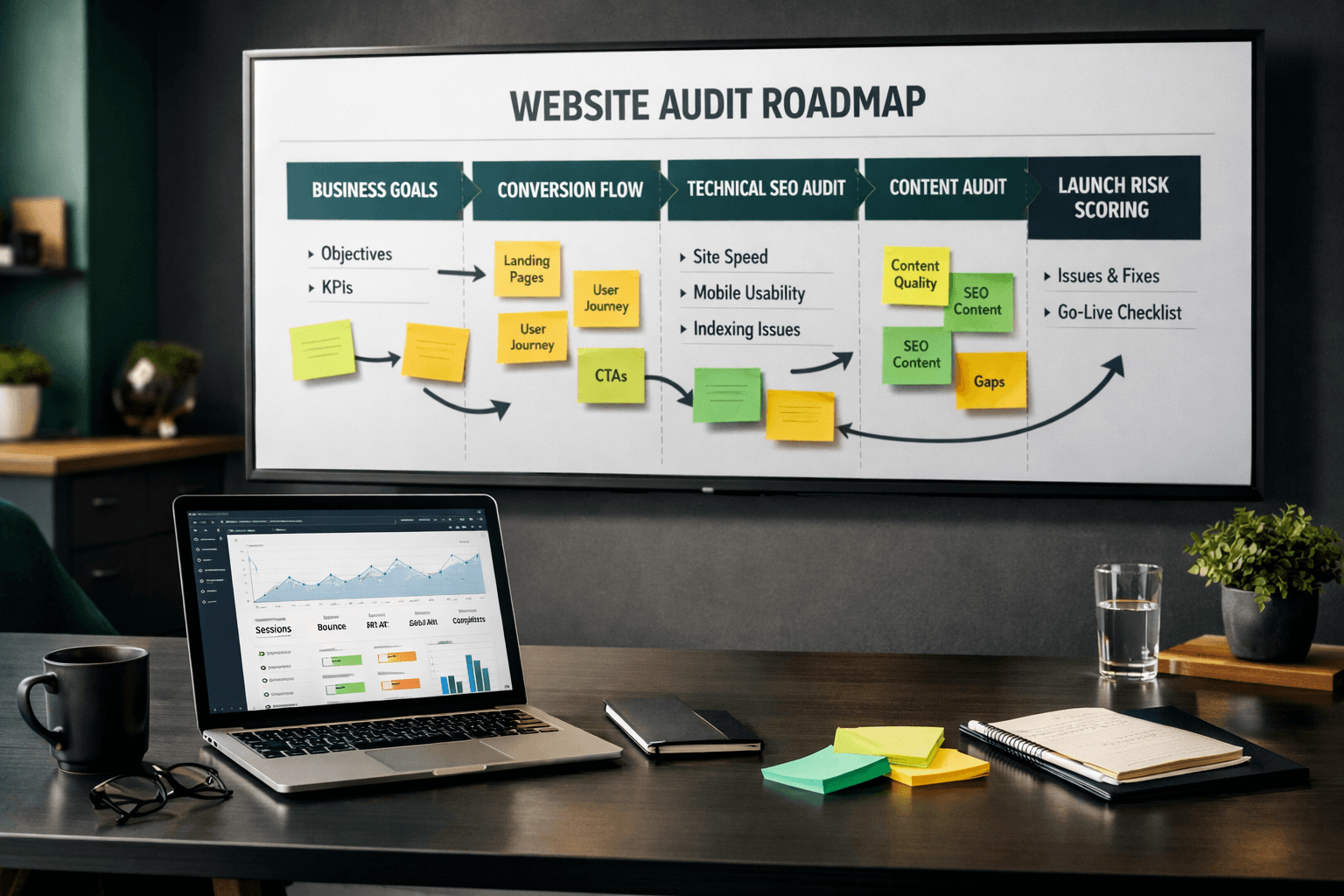
The Audit That Created the Roadmap (Part 2)
Most website redesign projects fail for one reason.
They start with layout ideas before they start with facts.
Need website design in 48 hours?
If you need a professional website live fast for Nigeria-based or international clients, the launch offer is built for that exact use case.
Explore the full service at website design in 48 hours, see how to launch your website in 48 hours, or review the done-for-you website launch details.
In Part 1, I explained why we chose a rebuild instead of a surface redesign: Why We Rebuilt, Not Redesigned.
Part 2 is the operational layer.
This is the website audit framework that turned "we need a better site" into an execution roadmap with clear priorities, predictable scope, and measurable outcomes.
This process was built while rebuilding J Luxe Medical Aesthetics, and it applies to most local service businesses that rely on search visibility and qualified leads.
If you are planning a website redesign in 2026, run this audit first.
Why a website audit matters more than mockups
A redesign can hide issues.
A website audit exposes them.
Before a single design decision, the audit should answer these questions:
- 1Which pages directly influence revenue?
- 2Where are qualified visitors dropping before contact or booking?
- 3Which SEO weaknesses are suppressing high-intent traffic?
- 4Which technical issues are increasing risk during launch?
- 5What should ship now vs after launch?
Without those answers, teams waste time debating preferences instead of solving bottlenecks.
For most small business websites, the highest-impact keywords are not abstract. They are practical terms like `website audit`, `SEO audit`, `technical SEO audit`, `website redesign`, `local SEO`, and `conversion rate optimization`.
Your audit should map those search and conversion opportunities directly to page-level action.
The four-layer audit framework we used
Our website audit combined four layers:
- 1Business and intent audit
- 2Conversion path audit
- 3Content and SEO audit
- 4Technical and performance audit
Each layer had a score, an owner, and a shipping deadline.
That is the difference between a useful audit and a document that never gets implemented.
1) Business and intent audit
We started by mapping each page to business intent.
Every URL had to have one primary job:
- attract discovery traffic
- pre-qualify service interest
- build trust and authority
- convert to contact or booking
If a page had no clear job, we merged it, rewrote it, or removed it.
This immediately reduced noise in information architecture and made the site easier to navigate for users and search engines.
We also listed the top revenue pages and top leakage pages.
Typical leakage patterns:
- broad pages with weak service clarity
- duplicate intent split across multiple pages
- no clear next step for high-intent visitors
- trust proof placed too late in the journey
This is not design criticism. It is conversion diagnosis.
2) Conversion path audit
Next, we ran a conversion funnel audit from first click to inquiry intent.
We looked at:
- entry pages from organic search
- in-page clarity above the fold
- CTA placement and sequence
- trust and proof timing
- friction in contact handoff
Key conversion questions:
- 1Can a first-time visitor identify the right service page in under 10 seconds?
- 2Is the next action obvious at every high-intent section?
- 3Is there enough proof before each CTA?
- 4Are mobile users getting the same decision clarity as desktop users?
This stage produced immediate wins.
Some pages did not need complete rewrites. They needed cleaner hierarchy, clearer headings, stronger service positioning, and better CTA cadence.
For deeper copy structure, use this guide with this post: High-Converting Service Page Guide.
3) Content and SEO audit
This was the core of the roadmap.
A technical SEO audit is only part of the picture. You also need an intent-based content audit.
We ran the SEO layer in five passes:
- 1Keyword intent mapping by service category
- 2URL and slug structure review
- 3Metadata and heading consistency check
- 4Internal linking flow audit
- 5Indexing and migration risk audit
#### Keyword and intent mapping
We mapped commercial and informational search intent to page types.
Commercial intent pages needed depth, specificity, and trust. Informational pages needed to support authority and route users into relevant services.
If you publish blog content without linking it to service conversion paths, traffic grows but revenue does not.
#### URL and hierarchy clarity
We audited slug quality and folder logic.
Weak URL structure causes topical confusion for crawlers and users.
Clean hierarchy improves crawl efficiency and relevance signals, especially in local SEO where service-location clarity matters.
#### Metadata and heading consistency
We audited titles, descriptions, H1 patterns, and heading hierarchy.
Common issues we found:
- duplicated intent in title tags
- weak value proposition in meta descriptions
- multiple H1-style blocks fighting for context
- headings that did not match search intent
This is where many websites lose click-through rate even when impressions are decent.
#### Internal linking architecture
Internal links were reviewed as a system, not page decoration.
Every supporting article had to route authority to service pages. Every major service page had to route back to trust and proof assets.
This improved both crawl flow and conversion path continuity.
For baseline checks, pair this with: Small Business Website SEO Checklist.
#### Migration risk scoring
Because this rebuild involved structural changes, we pre-scored migration risk.
Pages were flagged by:
- ranking and traffic dependency
- backlink sensitivity
- historical URL changes
- conversion value
High-risk pages received explicit redirect and validation plans before build work.
Part 3 will cover the full migration protocol: SEO Migration Without Losing Traffic.
4) Technical and performance audit
Finally, we audited the technical layer that determines shipping speed and long-term maintainability.
Scope included:
- rendering and route architecture
- reusable component boundaries
- metadata and schema generation pattern
- image and media handling strategy
- Core Web Vitals risk points
- QA and regression process
The rule was simple: If the team cannot update content and ship confidently, the architecture is not finished.
This stage also fed our performance decisions, later covered in: How to Make Your Website Load Fast.
The audit scorecard that forced prioritization
Most audits fail because findings are dumped into one giant list.
We used a scoring model to prioritize objectively.
Each issue received four scores from 1 to 5:
- Revenue impact
- SEO impact
- Effort to implement
- Launch risk
Then we calculated a practical priority:
`Priority = (Revenue + SEO + Risk) - Effort`
Not mathematically perfect. Operationally useful.
Anything with high impact and low effort moved first. Anything high effort with low impact was deferred.
This prevented the classic redesign trap: polishing low-value pages while high-intent pages underperform.
What the roadmap looked like after the audit
Once scores were complete, roadmap phases became obvious.
Phase 1: Stabilize structure and intent
- finalize page roles
- clean route hierarchy
- remove or merge duplicate intent pages
Phase 2: Repair conversion path
- rewrite high-intent service pages
- improve above-the-fold clarity
- align CTA sequence with decision stage
Phase 3: Strengthen SEO foundation
- implement metadata standards
- tighten heading and schema patterns
- execute internal linking plan
Phase 4: Control technical risk
- finalize reusable architecture
- enforce performance budgets
- validate mobile and Core Web Vitals behavior
Phase 5: Launch preparation and safeguards
- pre-launch technical QA
- redirect validation
- analytics and conversion tracking checks
- index and crawl verification
If you want launch operations detail, use: Website Launch Checklist for Small Businesses.
The website audit checklist you can copy
Use this before any redesign proposal is approved.
Business and strategy checks
- List your top 5 revenue pages.
- Define one primary job for every URL.
- Identify pages with no clear conversion role.
- Confirm primary audience and intent stage per page.
Conversion checks
- Test if first-time visitors can find the right service quickly.
- Confirm CTA clarity and consistency on mobile.
- Verify trust proof appears before key CTA moments.
- Reduce dead-end sections with no action path.
SEO checks
- Map keywords by page intent (commercial vs informational).
- Audit title and meta description quality.
- Validate heading structure and topical focus.
- Review internal links from blog posts to service pages.
- Flag pages with high migration risk.
Technical checks
- Measure Core Web Vitals and page speed constraints.
- Audit image payload and lazy-load strategy.
- Validate metadata/schema implementation consistency.
- Confirm QA and regression process before launch.
Prioritization checks
- Score each issue by impact, effort, and risk.
- Label each item as `must ship`, `post-launch`, or `experiment`.
- Assign clear owners and due dates.
This one framework turns "website redesign" into a build plan with accountability.
Common website audit mistakes to avoid
Mistake 1: Auditing only design
A visual review is not a website audit. You need search, conversion, and technical layers.
Mistake 2: Tracking only traffic, not intent
More sessions are meaningless if high-intent pages do not convert.
Mistake 3: Treating SEO and CRO as separate projects
SEO brings opportunity. CRO captures opportunity. You need both on the same pages.
Mistake 4: No scoring model
If everything is "important," nothing ships efficiently.
Mistake 5: No pre-launch migration risk plan
This is why rankings drop after launch even when the new site looks better.
What changed after the audit in this rebuild
Before the audit, the project looked like a broad redesign effort.
After the audit, we had:
- page-level business intent map
- prioritized backlog tied to outcomes
- SEO and migration risk controls
- technical constraints defined early
- cleaner scope, faster execution, lower launch risk
That clarity is why this series exists.
If you read the 8-part announcement, you have already seen the roadmap: J Luxe Website Rebuild Series: 8-Part Announcement.
This post is the mechanism behind that roadmap.
How to use this if you run a small business
If you are a founder or small team, do not wait for a full agency engagement to start this.
Run a lightweight version now:
- 1Identify your 5 highest-value pages.
- 2Run conversion and SEO checks on those pages only.
- 3Score issues by impact and effort.
- 4Fix high-impact low-effort items first.
- 5Build your full redesign scope from evidence.
If your current site still feels unclear, start here first: Why Your Website Isn't Getting Leads.
Then use this companion planning guide: Small Business Website Redesign Checklist.
Next in the series
Part 3 goes deeper into execution risk:
`03-seo-migration-without-losing-traffic`
We will cover redirect maps, canonical handling, sitemap and indexing checks, and launch validation workflows to protect rankings during structural change.
FAQ
What is the difference between a website audit and an SEO audit?
A full website audit includes business intent, conversion flow, content quality, SEO structure, and technical performance. An SEO audit focuses primarily on search visibility and indexation factors.
How long should a small business website audit take?
A focused audit for core revenue pages can be completed in one to three working sessions, depending on site size and data access.
Do I need paid tools to run this audit framework?
No. Paid tools help at scale, but the framework works with analytics, Search Console, manual page review, and a disciplined scoring model.
Should I do this before or after hiring a designer?
Before. The audit defines the problems design should solve and prevents expensive revision loops.
Can this framework work outside medical aesthetics?
Yes. Any local service business that depends on search visibility and lead conversion can use the same process.
A successful rebuild is not driven by trends.
It is driven by a clear website audit, a practical SEO strategy, and ruthless prioritization.
That is how you build a site that ranks, converts, and scales.
Related reads
- Why We Rebuilt, Not Redesigned (Part 1)
- J Luxe Website Rebuild Series: 8-Part Announcement
- Case Study: How We Engineered J Luxe Aesthetics to Dominate Local Search
Ready to launch
Launch your website in 48 hours with a done-for-you setup
If this article helped you clarify the next step, the launch offer gives you a mobile-first business website, domain guidance, hosting setup, and a clear CTA flow without dragging the project out.
Chat on WhatsAppWebsite design in 48 hours for businesses that need to go live fast
The 48-hour launch offer is built for businesses that need a clean, mobile-first site live fast with pricing, CTA flow, and basic SEO already handled.
See the done-for-you website launchRelated posts
More articles to help you get better rankings and more leads.
Part 4 of the J Luxe rebuild series: how to write service pages that rank in local SEO and convert visitors into qualified enquiries using a practical, repeatable framework.
Part 5 of the J Luxe rebuild series: how to combine premium website design, Core Web Vitals, and conversion-focused UX without sacrificing speed or SEO performance.
An 8-part series on rebuilding jluxemedicalaesthetics.com, covering SEO migration, service page conversion, launch strategy, and Next.js architecture decisions.