
Writing Service Pages That Convert: Service Page SEO and Conversion Copy Framework
Part 4 of the J Luxe rebuild series: how to write service pages that rank in local SEO and convert visitors into qualified enquiries using a practical, repeatable framework.
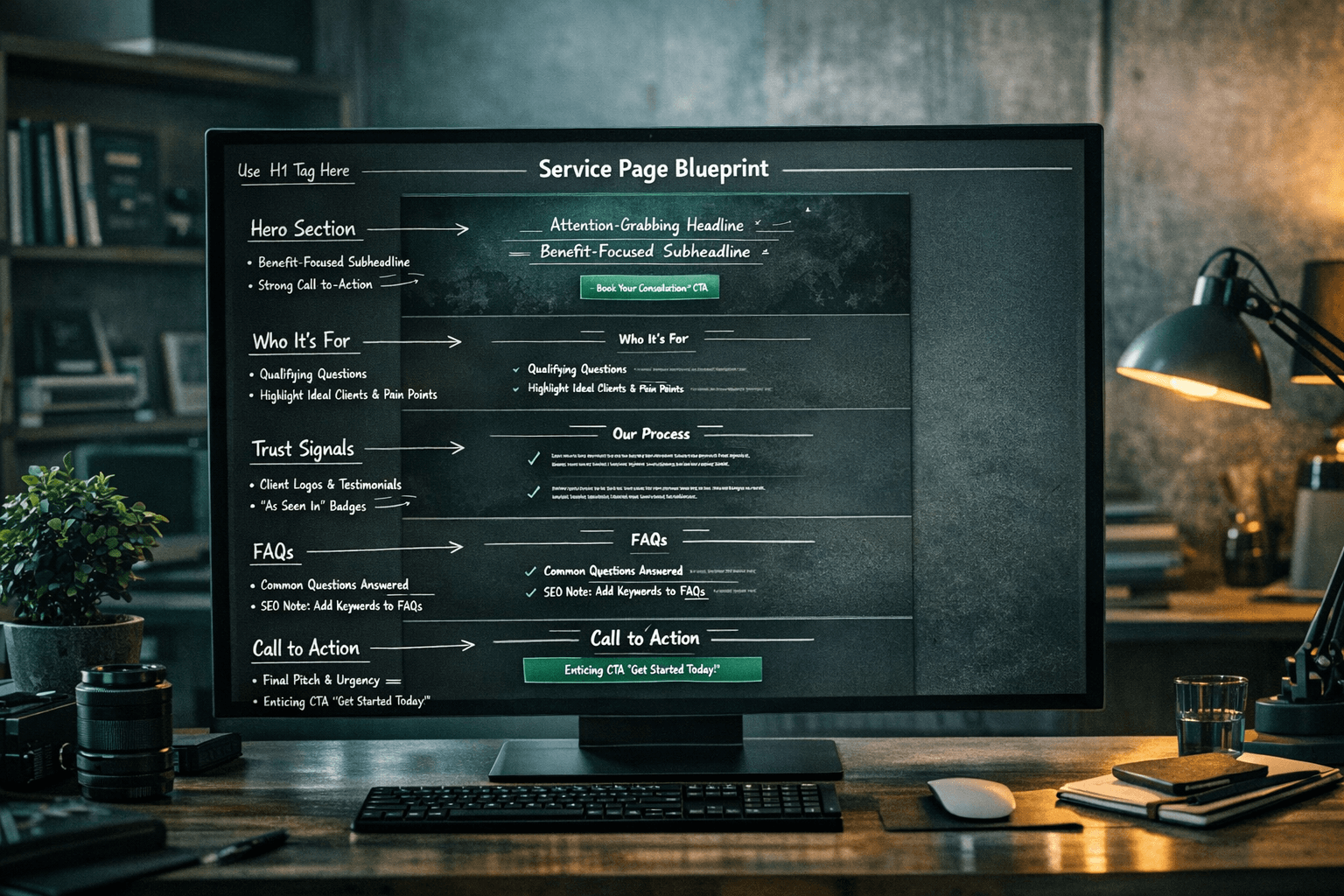
Writing Service Pages That Convert (Part 4)
Most service pages fail for one reason.
They try to look professional before they try to reduce decision friction.
Need website design in 48 hours?
If you need a professional website live fast for Nigeria-based or international clients, the launch offer is built for that exact use case.
Explore the full service at website design in 48 hours, see how to launch your website in 48 hours, or review the done-for-you website launch details.
You can have a beautiful page, clean typography, and polished visuals, and still get weak enquiries.
Why?
Because visitors still do not get clear answers to their real buying questions:
- Is this service right for me?
- Is this business credible?
- What happens next?
- How do I start?
In Part 3, we covered migration safety: SEO Migration Without Losing Traffic.
Part 4 is about conversion mechanics.
This is the exact service page SEO and conversion copywriting framework we used during the J Luxe rebuild to make pages rank better, read better, and convert better.
If you are planning a broader rebuild, use this small business website redesign checklist first so page-level copy decisions match the full conversion strategy.
Why most service pages do not convert
Most pages are written as brochures.
They explain what the business does, but not how the visitor should decide.
Common breakdowns:
- generic opening copy that could fit any business
- no clear difference between this service and alternatives
- trust signals hidden too low on the page
- FAQ sections that do not answer real objections
- CTA placement that is either too aggressive or too late
The result:
- weaker user engagement
- lower conversion rate
- lost high-intent traffic
If your traffic is fine but leads are inconsistent, this is usually the page-level bottleneck.
The real objective of a service page
A high-performing service page does two jobs at the same time:
- 1rank for local and commercial intent keywords
- 2convert interested traffic into qualified enquiries
That means your page must serve both search intent and human decision intent.
SEO without conversion is expensive visibility.
Conversion without SEO is limited reach.
You need both on the same URL.
The keyword strategy we used for service pages
For each page, we built a keyword cluster around one primary commercial term and supporting intent terms.
Example structure:
- primary keyword: `service + location`
- secondary keywords:
- `best + service + location`
- `service cost`
- `service recovery`
- `service before and after`
- `service consultation`
This keeps the page focused for ranking while giving enough semantic coverage for real user questions.
For small business websites, practical high-volume terms usually include:
- `local SEO`
- `service page`
- `website copywriting`
- `conversion rate optimization`
- `small business website`
The page should not feel stuffed.
It should feel clear.
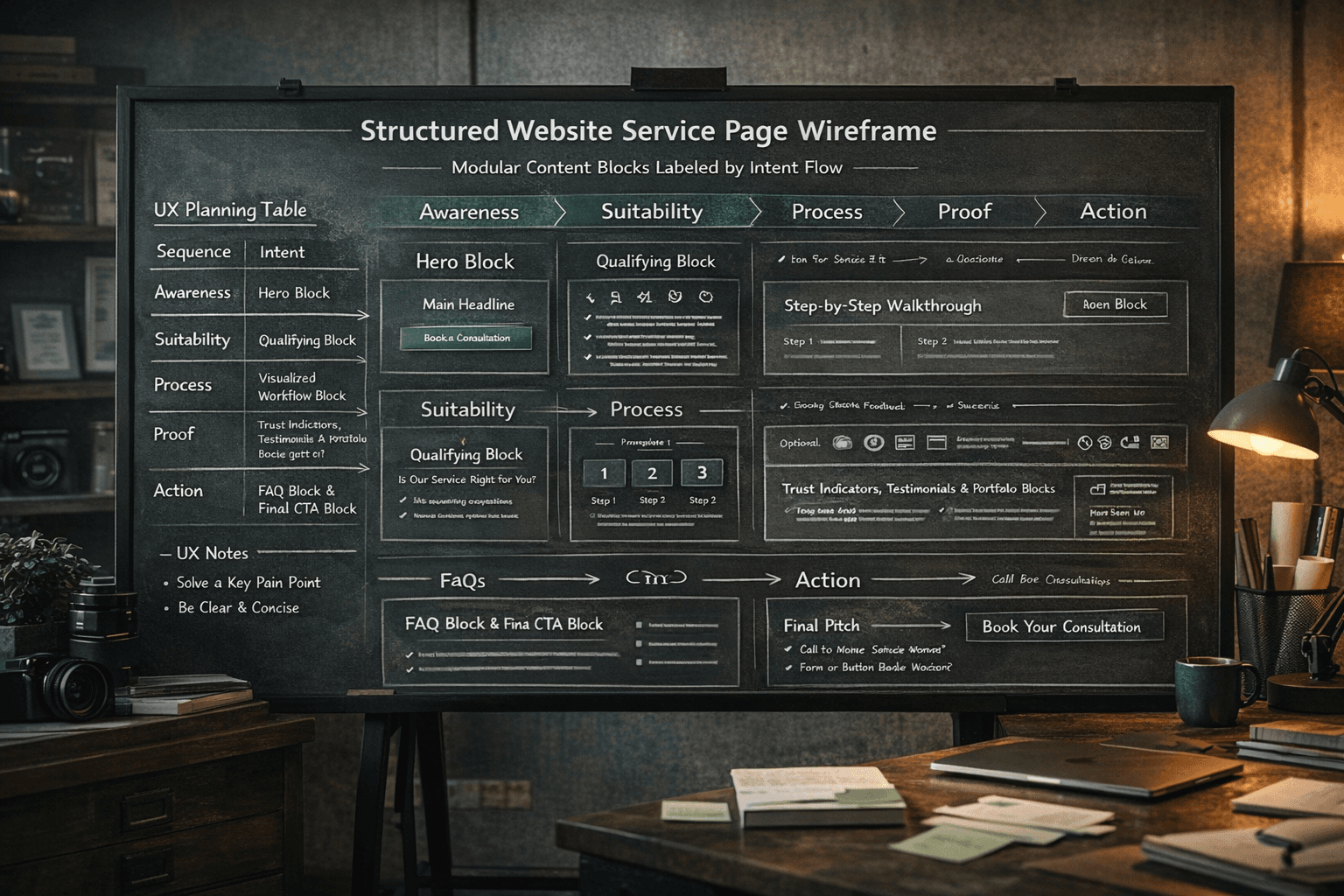
The service page structure that converts
This is the sequence we used on core pages.
1) Intent-matched hero section
Above the fold must answer:
- what the service is
- who it is for
- what result is expected
- what action to take next
Include one primary CTA and one support CTA.
Do not force five equal actions.
2) Suitability and outcome clarity
Visitors need a fast self-qualification block:
- who this service is ideal for
- who should avoid it
- expected outcomes and boundaries
This reduces unqualified leads and increases trust.
3) Process and what-to-expect
Outline the flow in practical steps.
Good process sections reduce anxiety and increase intent.
4) Safety, standards, and proof
Trust-sensitive services need explicit credibility signals:
- qualifications or standards
- consultation process
- aftercare expectations
- review or testimonial support
Trust cannot be implied.
It must be visible.
5) Pricing route and booking route
You do not always need a full price table.
But you do need pricing clarity:
- starting point
- what affects price
- how to get exact quote
Then provide the clear next action.
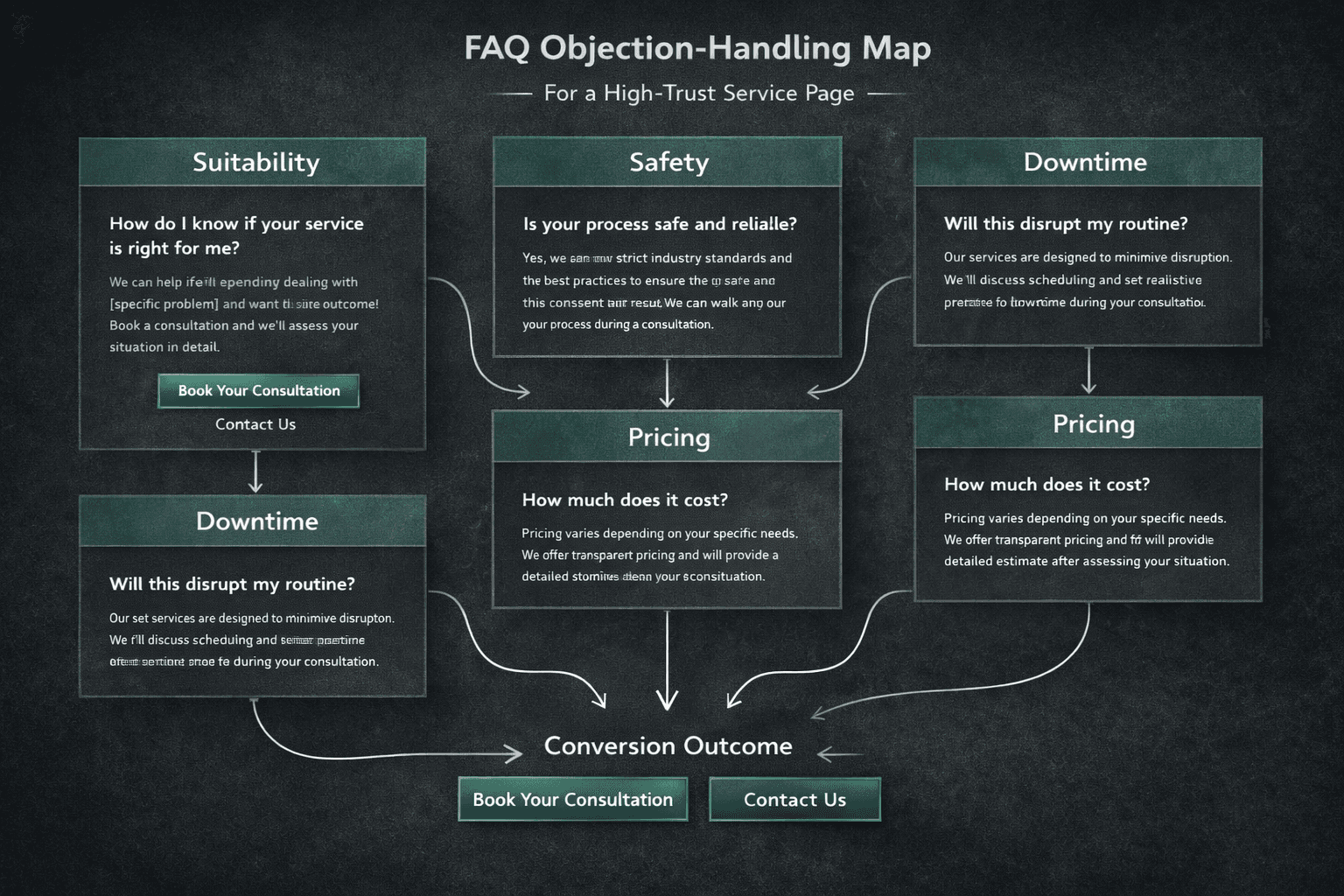
6) Objection-handling FAQ
Use FAQ for real hesitation, not filler.
Typical high-converting questions:
- downtime
- suitability
- timeline
- pain and recovery
- follow-up process
- policy boundaries
7) Final conversion block
Re-state value in one clear sentence and repeat the primary CTA.
Never make users scroll back up to convert.
Copy rules that improved conversion rate optimization
We used these non-negotiable writing rules.
Rule 1: clarity before persuasion
If users do not understand the offer, persuasion fails.
Rule 2: specificity over hype
Replace vague claims with explicit information.
Weak:
"We provide excellent service."
Strong:
"Consultation-led treatment planning with clear aftercare guidance."
Rule 3: confidence without overpromising
In trust-sensitive categories, exaggerated copy hurts conversion.
Balanced claims convert better than aggressive claims.
Rule 4: every section answers one question
If a section has no clear user question behind it, remove it.
Rule 5: one page, one primary action
Multiple competing paths increase friction.
Pick one primary conversion goal per page.
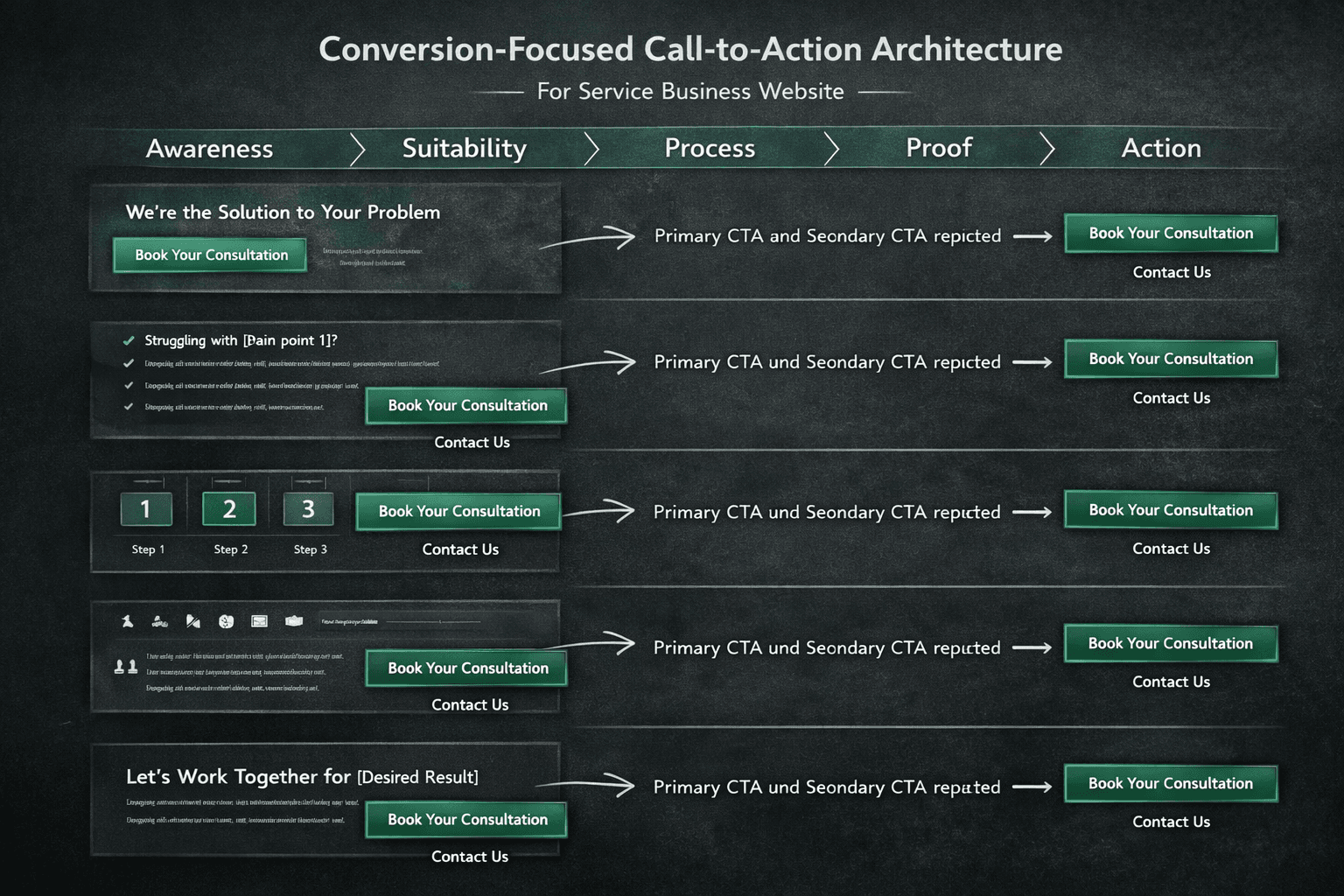
CTA architecture that increased action rate
Most pages underperform because CTA strategy is weak, not because traffic is low.
We used a simple CTA system:
- primary CTA: booking/consultation intent
- secondary CTA: support path (contact/WhatsApp)
Placement model:
- 1above the fold
- 2after process/trust block
- 3final section before page end
This keeps action points aligned with visitor readiness.
SEO elements we enforced on every service page
For service page SEO consistency, every page had to pass this checklist:
- one keyword-aligned H1
- optimized title tag and meta description
- clear H2/H3 hierarchy by user intent
- internal links to related services and supporting posts
- FAQ section aligned to real search questions
- optimized image alt text
- clear canonical and indexability setup
If any one of these was missing, the page was not considered launch-ready.
For base checks, use: Small Business Website SEO Checklist.
Internal linking: where ranking and conversion meet
Internal linking is not just for crawl.
It controls user movement.
Service pages should link:
- to supporting education pages (for trust)
- to related commercial pages (for intent depth)
- to final conversion routes (for action)
Supporting blog posts should link back to service pages using intent-matched anchor text.
That is how content SEO supports revenue, not just pageviews.
The mistakes we intentionally avoided
- 1Writing one generic template and cloning it across all services
- 2Burying key trust details below long filler sections
- 3Leading with technical jargon before visitor context
- 4Forcing a hard CTA before enough decision clarity
- 5Ignoring local SEO intent in headings and metadata
- 6Treating FAQ as decoration instead of conversion support
Each of these reduces either ranking performance, conversion performance, or both.
Reusable service page framework you can copy
Use this structure directly:
- 1H1 with clear service intent
- 2Short value intro (2 to 3 lines)
- 3Who this is for
- 4What to expect
- 5Safety/trust/quality signals
- 6Pricing route and next step
- 7FAQ with real objections
- 8Final CTA section
If your page cannot be outlined this way, it is not ready to publish.
For deeper reference, combine this with: High-Converting Service Page Guide.
What changed after this rewrite phase
After rewrite and structure updates, pages became easier to scan and easier to act on.
Visitors could:
- identify relevance faster
- compare options with less confusion
- move from research to enquiry with fewer dead ends
That is what service page conversion copy should do.
Not impress.
Convert.
Next in the series
Part 5 moves to visual execution:
`05-premium-design-without-slow-pages`
We will break down how we designed a premium user experience while protecting performance, Core Web Vitals, and mobile usability.
FAQ
What is a service page in SEO?
A service page is a commercial intent page designed to rank for service-related queries and convert visitors into enquiries or bookings.
How long should a service page be?
Length depends on intent and complexity. Focus on complete decision clarity, not word count alone.
Should every service have its own page?
If search intent and offer clarity are distinct, yes. Separate pages usually perform better for both SEO and conversion.
Is FAQ really important for conversion?
Yes. FAQ sections handle objections that block action and improve both user confidence and topical relevance.
What is the biggest service page copy mistake?
Writing broad, generic copy that sounds polished but does not answer the visitor's real buying questions.
When service pages are structured around real user decisions, rankings become more durable and conversions become more consistent.
That is how a small business website stops being a brochure and starts behaving like a sales system.
Related reads
- SEO Migration Without Losing Traffic (Part 3)
- The Audit That Created the Roadmap (Part 2)
- J Luxe Website Rebuild Series: 8-Part Announcement
- High-Converting Service Page Guide
Ready to launch
Launch your website in 48 hours with a done-for-you setup
If this article helped you clarify the next step, the launch offer gives you a mobile-first business website, domain guidance, hosting setup, and a clear CTA flow without dragging the project out.
Chat on WhatsAppWebsite design in 48 hours for businesses that need to go live fast
The 48-hour launch offer is built for businesses that need a clean, mobile-first site live fast with pricing, CTA flow, and basic SEO already handled.
See the done-for-you website launchRelated posts
More articles to help you get better rankings and more leads.
Part 2 of the J Luxe rebuild series: how a structured website audit, technical SEO audit, and conversion audit created a clear rebuild roadmap without wasted redesign work.
Part 5 of the J Luxe rebuild series: how to combine premium website design, Core Web Vitals, and conversion-focused UX without sacrificing speed or SEO performance.
Part 1 of the J Luxe rebuild series: why a full website rebuild beats a surface redesign when you want better SEO, higher conversion rates, and more sales.